You Only Have 24 Hours
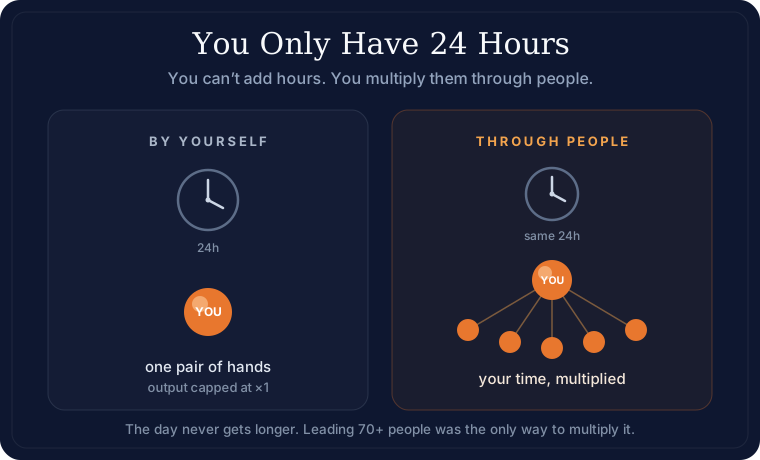
In my first year at TecSinapse, Joe stepped back. He was the partner and co-founder, and he decided to leave the technical and product side to me and Rafa. Before he handed it over, he told me something I have never forgotten. He said I was very good, but that I had to learn to be a leader, because I would always have only 24 hours, and the only way to multiply my time was by leading people.
That line is the whole model. You do not get more hours. Nobody does. The day does not stretch because you are talented or because you care more than the next person. So the question is not how to work harder inside your 24 hours, it is how to multiply them, and the answer is people, trust, and judgment. Leadership is leverage on finite time.
I did not learn this from Joe first, honestly. I learned the shape of it as a kid, on a Counter-Strike team, where I was the one calling the plays. The in-game leader, the caller. I did not have a word for it back then. I just knew that five people doing their own thing lost to five people moving together, and that somebody had to hold the picture of the whole round in their head while everyone else focused on their corner. That was leadership before I had ever heard the term. Joe just gave it a name and a reason years later.
So let's be clear about what this model is and what it is not. It is not about being in charge, it is not about a title, and it is definitely not about being the smartest person in the room. It is about taking the thing you can do well and making it happen through other people, so that the output is no longer limited by your own two hands and your own 24 hours. A leader is a multiplier. That is the entire job.
Over the years I have led 70+ people. And every time the math is the same. You cannot get into the weeds on everything. You physically cannot. So you choose the few things where your own hands matter most, and for everything else you lead, you trust, you multiply.
That is where this model meets Get Into the Weeds. Those two are not enemies, they are partners that need each other. Get into the weeds on the few things that decide everything, and lead so that the rest gets done at a scale your hands could never reach. If you only got into the weeds, you would be stuck doing one thing at a time forever. If you only led, you would be a manager talking about work you no longer understand. You need both, and the trick is knowing which moment is which.
Now, people will tell you that leading means letting go and never looking closely, that watching the work is "micromanaging." I was told I was micromanaging once, and it hit me hard, until I actually thought about it. As I said in Get Into the Weeds, looking closely is not control. Leadership is a transfer of trust, the same way sales is a transfer of enthusiasm. So when I get close to someone's work, it is almost never because I want to control them, it is because a skill is missing or trust is still being earned, and both of those are my job as the leader, not a flaw in the person.
And once the trust is there, I get out of the way completely. The best example I ever lived was at Tiny. As CEO of Meteor under Tiny, I had total autonomy. Real autonomy, not the kind people put on a slide. The joke I always make is that the only thing I could not change was my own pay hahaha. Everything else was mine to decide. Andrew Wilkinson talks about this openly, how they buy great companies and then let great people run them, and my experience matched his words exactly. Freedom and responsibility, together, in practice. That is what good leadership feels like from the inside, and it is what I try to give the people who work with me.
This is also why I care more about people than process. When people are mature and capable, the process matters less, because they will make the best decision regardless of what the rulebook says. When people are new, the process is a safety rail so they do not walk into known problems. But the real factor is never the process, it is trust. Do you trust that your team is trying to make the best decision for the company, rules or no rules? If you do, relax the process and let them decide. If you fill the place with rules for everyone just because of a few bad actors, you end up like the public restrooms in Brazil with signs saying "do not pee on the floor." Do not run a company like that.
A few things I believe about leading, plainly:
- People over process, always. People are more intelligent than any hard-coded rule.
- Freedom and responsibility come as a pair. You do not get one without the other.
- Work with friends and curate talent without mercy. Friends trust, friends do not fake, and that alone cuts most of the pressure at work.
- Lead as yourself, not a softened, careful, corporate version of you. The softened version fools no one and helps no one.
That last one matters more than people think. There is a temptation, when you become the leader, to sand yourself down into something safe and agreeable. Do not. The people worth leading can smell a costume. Lead with your real opinions, your real standards, your real laugh. You are not multiplying your time so you can become a blander person, you are multiplying it so the real you reaches further.
Here is the part that keeps this whole model honest, and it is where it bumps into Protect the Machine and Family First. The reason you multiply through people is precisely so you do not multiply by burning more of your own hours. That is the cheating answer, and it always loses. You can squeeze a few more hours out of yourself this week, sure, but you cannot do it forever, the machine breaks, and you are back to losing the war you were trying to win, only now with less of yourself to spend. Leadership is the honest way to get more done without stealing it from your sleep, your health, or your family. You still only have 24 hours. The whole point is to stop trying to win by spending more of them.
So if you find yourself drowning, working longer and longer, doing everything yourself because nobody does it quite like you do, hear Joe's voice the way I still do. You are very good. That was never the question. The question is whether you will learn to be a leader, because you will always have only 24 hours, and the only way to multiply them is through people you trust.
Go build that. And then go home. The hours you save are not for more work, they are for the people who don't last forever, and neither do you.