The Compounding Effect
One Pilates session does not transform a body. One customer conversation does not build a company. One documented lesson does not create an operating system. One small product improvement does not make a platform dominant. One investment writeup does not create judgment. One morning with Lucas does not define fatherhood. None of it looks like much on the day you do it, and that is exactly why people give up on it.
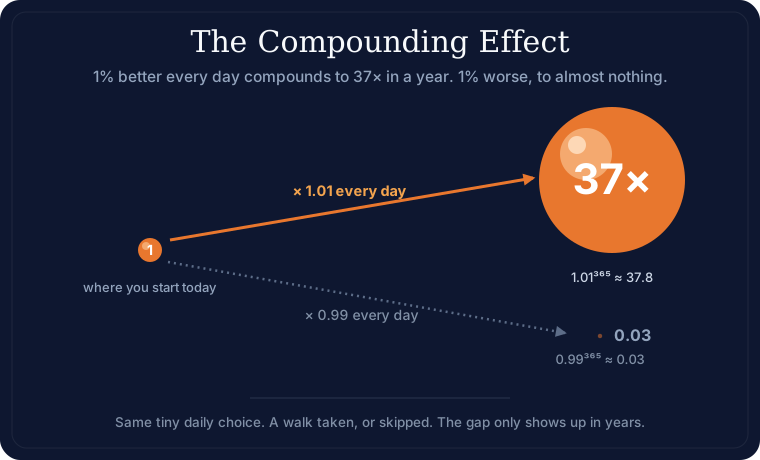
The Compounding Effect is just this: small repeated gains end up much larger than they look at the start. Knowledge, reputation, product quality, customer trust, health, money, almost none of it improves in a straight line. When the same useful effort repeats long enough, each layer starts building on the layers under it, and the base you act from keeps getting higher. That is the whole magic, and it is boring before it is impressive, which is why it is easy to respect and hard to actually live.
This does not mean you avoid new things. It means you prefer new work that uses what you already have: skills, relationships, code, infrastructure, customer knowledge, judgment. The best opportunities usually come from pointing a new direction at an old base.
Let me make this concrete with the academic version, because that is where my own compounding really started. On the last day of my first year in college, in the parking lot, my statistics professor, Faccenda, told me I had a lot of potential but joked around too much. That was it. He was not being cruel, he was just honest, and that one sentence echoed in my head all vacation. From the second year on I became the best student in my class, my lowest grade was an 8.5, and most of them were 9.5s and 10s. Nothing changed about my ability between December and February. What changed was that I started repeating the right effort, and once the curve began, it never stopped.
Java was the same bet, played long. In college I told Lu that Java would be our livelihood, and I was right, it paid the bills for years. Then around 2016 I shifted my focus to JavaScript, but I did not throw the old base away, I stood on it. Years of thinking in one language made the next one cheaper to learn, and the next one after that.
QuaveONE is a clear example. It compounds everything Quave already learned in cloud, DevOps, Meteor, deployment, customer support, and running production software. It exists because my experience as CTO and CEO of a cloud business, plus Edimar's deep DevOps knowledge, opened a clearer opportunity to build a cloud platform. It is not a random idea detached from history, it grows from previous layers, and a new company built on old learning is a very different animal from a new company built from zero.
It was also a deliberate bet, not a lucky one. We tried other segments first, like a product for creators, but we did not know much about creators and it did not work as well. So we returned to what we knew deeply: I was Meteor's CEO and CTO for about three years, I had been doing servers, deploys, and CI/CD for many years, and Edimar had great ideas on how to build an affordable cloud. The product everyone celebrates today is just the segment where the base we already had was deepest. We did not pick the newest idea, we picked the one with ten years under it.
Same thing with Quave Run. Treat each vertical experiment as its own island and the work scatters. Capture the shared AI, software, workflow, sales, and customer-learning pieces, and each vertical starts feeding the next one. A real estate workflow can teach you something about pharmacies. A pharmacy discovery process can teach you something about construction. A prompt library, a code module, a sales script, a workflow map, a customer memo, any of those can turn into reusable infrastructure instead of dying with the project.
This goes back to TecSinapse, where we changed how we built new modules. We used to begin every client from zero, a blank page, every single time. Then each client got a portal where we composed tools we already had instead of rebuilding them. The work we did for the last client became the head start for the next one, the base kept rising, and starting from zero became the one thing I tried hardest never to do again.
So the question I keep asking is simple: what should this effort leave behind? If the answer is nothing, compounding is weak. If every effort leaves behind better judgment, better assets, better relationships, or better systems, compounding starts.
Relationships compound the same way, and they are the slowest curve of all, which is exactly why people underrate them. In 2018 I helped a friend at ClearSale International with two developers, a small project through Quave. Those two are still with me in 2026. During that small ClearSale project, over lunch in New York, I casually mentioned to Jordan, one of Pathable's founders, that we were helping ClearSale. That one offhand sentence turned into a multi-year contract that made Pathable, by far, Quave's biggest client at the time. I did not plan any of that. I just kept showing up for people over years, and one day a casual mention paid off in a way no cold pitch ever could.
This is also why documentation matters to me. It can look like administrative busywork, but it is really memory made reusable. A lesson that lives only in conversation has a short half-life. A lesson written down can be found, challenged, improved, and used by someone else later.
I have a private repo called mental-models where I collect the mental models I use to think, decide, and explain things to myself. Each definition, action, and question turns a temporary thought into a durable object. The repo is not valuable because every file is perfect, it is valuable because it gives thinking a place to pile up. This book works the same way. A chapter written today becomes material I can edit tomorrow, a personal story added later gives a model emotional weight, a model clarified in one chapter quietly changes how another chapter works. The book compounds because writing makes thinking visible.
Health compounds too, and that is one of the hardest places to apply it. The cleanest proof I have is the one I already told you about: walking Mimosa twice a day. No single walk moved the scale, nothing dramatic happened on any given afternoon, and ten months later it was 26 kg gone. That is the curve exactly, invisible on the day, undeniable in the rear-view mirror. The same logic carries the harder seasons. After surgery, recovery is not one heroic comeback, it is repeated body-compounding actions, Pilates, gym, mobility, strength, and eventually playing with a ball again when the body allows it. The body gets more capable by default only if the right actions keep repeating.
There is a strange humility in all of this. You have to accept that today's action may not feel important. You have to act without immediate proof, keep going before the curve becomes visible, and resist the urge to constantly start over, because starting over feels exciting and compounding feels slow.
That is where most people fail. They switch too early, chase the novelty, abandon the previous layer before it had time to produce. They treat every customer, product, or investment decision as a one-off, they never systematize the lesson, so the same learning has to happen again and again. The hidden cost of not compounding is repeated forgetting. A company that does not document repeats its mistakes. A person who does not reflect repeats their patterns. A body that is not trained slides back to fragility. A reputation you do not protect consistently stops being reliable. A family that gets only occasional attention does not feel secure because of one grand gesture.
So respect the small repeated action. Not because small is enough on its own, but because small, repeated long enough, becomes a different category entirely.
This also changes how I think about opportunity. The best one is not always the newest. Sometimes it is the one that uses ten years of accumulated context in a way that suddenly turns valuable, and the person hunting only for novelty walks right past the power of the base they already built.
The question I want to ask more often is: what am I doing now that future Filipe will be grateful was repeated? And the opposite one: what am I repeatedly doing that future Filipe will wish I had stopped earlier?
Because compounding works both ways. Good habits and bad ones, trust and resentment, health and neglect, they all compound. So the model is not only optimistic, it is a warning. Every repeated action is a vote for a future base, so pick the votes you actually want to win.